

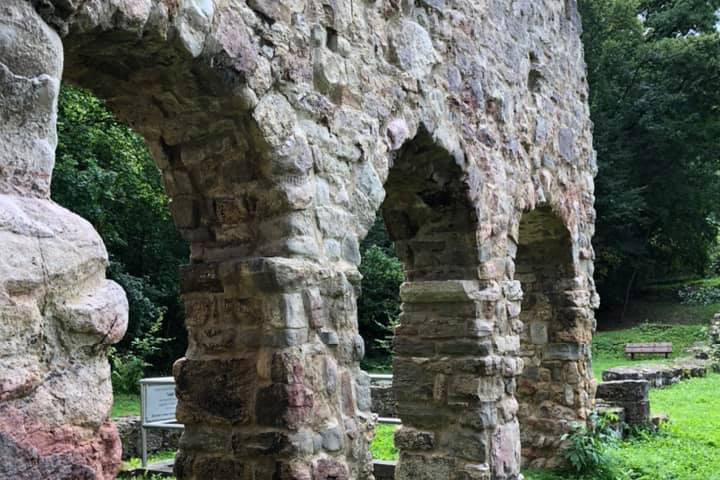
To help you understand castle architecture and history, here is a list of terminology specific for castles.
- Alure – also called “wall walk,” the highest walkway around the castle wall, located behind the battlements.
- Arrow Slit (German: die Schießscharte) – Narrow vertical openings in the walls for archers to shoot through while being protected. On the inner side of the wall, the window frame was splayed to give the archer the best angles for shooting (see embrasure).
- Bailey (German: der Burghof) – A courtyard area within the castle walls. If the castle has multiple concentric curtain walls, the castle may have an inner bailey, an outer bailey, or multiple baileys.
- Barbican (German: die Barbakane)– A fortified outpost or gateway, often positioned in front of the main gate of a castle.
- Barbizan (German: das Mauertürmchen)- a small turret structure extending out from a wall. Used as a lookout post.
- Barrel Vault (German: das Tonnengewölbe) – a semicircular roof created by aligning multiple arches along a curve.
- Bastion – a polygonal structure projecting out from the curtain wall, giving the castle defenders a better view of and access to castle attackers.. Also see ravelin.
- Batter – a sloping face at the bottom of a defensive wall. It adds strength to the wall due to extra thickness, and the angle offset made it more difficult to climb with a ladder or approach with a siege engine. Also called plinth or talus.
- Battering Ram (German: der Rammbock) – A heavy, wooden siege weapon used to break through castle gates or walls.
- Battlements (German: die Zinnen) – A wall along the alure with gaps from which defenders could shoot arrows or stones. Battlements were topped with crenellations, alternating high sections (merlons) and low sections (crenels). Also called a parapet.
- Belfry – a siege tower on wheels that could be used to approach a castle while providing cover for the attackers.
- Bower (German: die Kemenate) – A private, peaceful room for the lady of the castle
- Castle built on a hill (die Höhenburg)
- Castle built on a plain (die Niederburg)
- Castle built with a moat containing water (die Wasserburg)
- Clerestory (German: der Obergaden)– The upper part of a castle wall with windows, used to allow light into the interior.
- Corbel (German: die Konsole) – A stone or wood projection from a wall which supports a beam or overhanging structure.
- Crenel (German: das Zinnenfenster) – The low sections of a battlement for defense, interspersed with merlons, the high sections of battlements for defense. Archers hid behind merlons, and shot through the crenels.
- Crow-step gable (German: die Treppengiebel) –
- Curtain Wall (German: der Ringmauer, der Burgmauer)– The main perimeter wall of the castle, typically extending between towers.
- Donjon (see Keep)
- Drawbridge (German: die Zugbrücke) – A bridge that can be raised or lowered to allow or block access across the moat.
- Dungeon (German: das Burgverlies) – A subterranean prison or holding cell within the castle.
- Embrasure – the angled and splayed opening on the interior side of an arrow slit in a wall or tower. It provided the defender room to stand and maneuver.
- Garderobe – latrine, toilet
- Gatehouse (German: das Torhaus)– The structure housing the main entrance to a castle, often reinforced for defense.
- Great Hall – banquet and reception hall for the castle
- Hoard/Hoarding – a wooden structure extending over the curtain wall that allowed defenders a secure location and good view of their attackers. Hoardings were not considered attractive additions to the architecture and were often removed during peaceful periods.
- Keep, or Donjon (German: der Bergfried) – A fortified tower, typically the strongest and most defensible part of a castle, and the last shelter for castle residents under siege. It often had a door above ground level, only reachable with a ladder, and once everyone had entered the keep, the ladder was pulled up to prevent the enemy from entering the keep.
- Machicolation or Murder Hole (German: die Pechnase, das Gussloch) – A hole between the supporting corbels of a battlement, used for dropping projectiles or boiling liquids (oil, water, molten lead) on attackers.
- Merlon (German: die Zinne)– high section of a battlement that archers and castle defenders hid behind.
- Moat (German: der Burggraben) – A deep trench surrounding a castle, either filled with water or dry, used for defense. The moat prevented soldiers in siege towers or soldiers carrying battering rams from approaching the castle.
- Motte-and-Bailey (German: die Motte, die Turmhügelburg) – Early medieval castle design consisting of a hill (the motte) topped by a wooden tower and other buildings. For defense, the buildings were surrounded by a wooden spiked fence (palisade) and a ditch. The palisade enclosed the bailey.
- Murder Hole – see Machicolation
- Mural Tower – tower built into the curtain wall to provide flanking fire along the curtain wall
- Parapet – see Battlements
- Portcullis (German: das Fallgatter) – A heavy gate that could be dropped vertically to block entry into the castle at the gatehouse.
- Postern Gate (German: die Poterne) – A smaller, hidden gate used for discreet or emergency exits. It was also used as a “sally port” where defenders would take small excursions outside to attack besiegers.
- Rampart (German: das Bollwerk) – A defensive wall or embankment designed to protect a castle.
- Ravelin – a triangular structure jutting out from the curtain wall, giving the castle defenders a better view of and access to castle attackers. See also bastion.
- Siege Engine – A mechanical device used in the siege of a castle, such as a battering ram, belfry, or trebuchet.
- Solar – a large room with living space, usually on an upper floor in the keep.
- Trebuchet (German: das Trebuchet)– A large medieval siege engine used to hurl heavy projectiles at a castle.
