

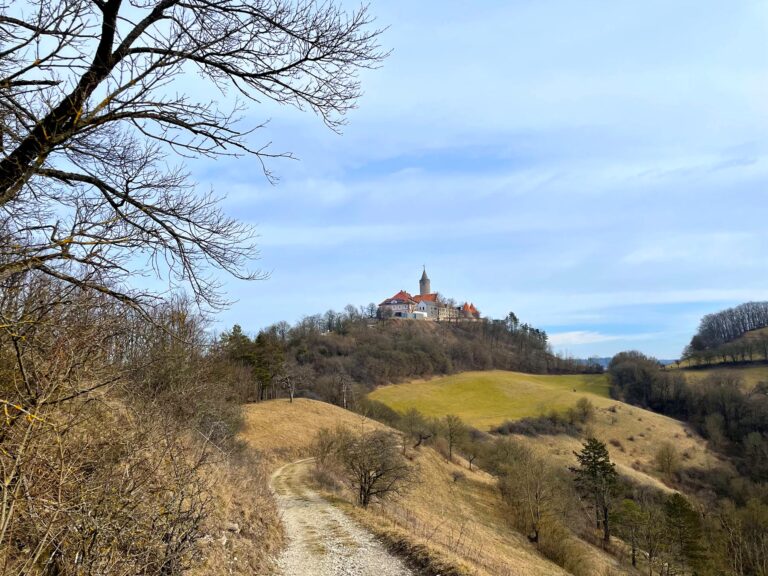
Perched high on a peak above the Saale River valley in Thuringia, Germany, the Leuchtenburg castle has a commanding panoramic view over the villages below. At an elevation of 395 m (almost 1300 feet), it can be seen from many kilometers away on a clear day.
Leuchtenburg can be translated as “the illuminated castle.” In the middle ages, the trees and bushes below the castle would have been cut down to prevent enemies from hiding in the foliage. Because the ground underneath this foliage is primarily white limestone, the castle glowed brightly in the sun. It’s not surprising, then, that it was referred to as the “Queen of the Saale Valley.” My family has taken many visitors to this well-preserved example of a medieval castle.
How to get there
The Leuchtenburg castle sits above the city of Kahla in Thuringia and can be reached by highway B88. Most visitors park below the castle and walk up a short paved trail to reach it.
By the end of 2025, the castle will be accessible with a funicular train (Schrägzug) that will take visitors up the hill, making the castle more accessible to visitors with limited mobility. Many parts of the castle are wheelchair accessible, including the visitor’s center, the porcelain museum, and the restaurant. In addition there is the “Panaromaweg,” a U-shaped walkway around the castle with spectacular views that is completely barrier-free.
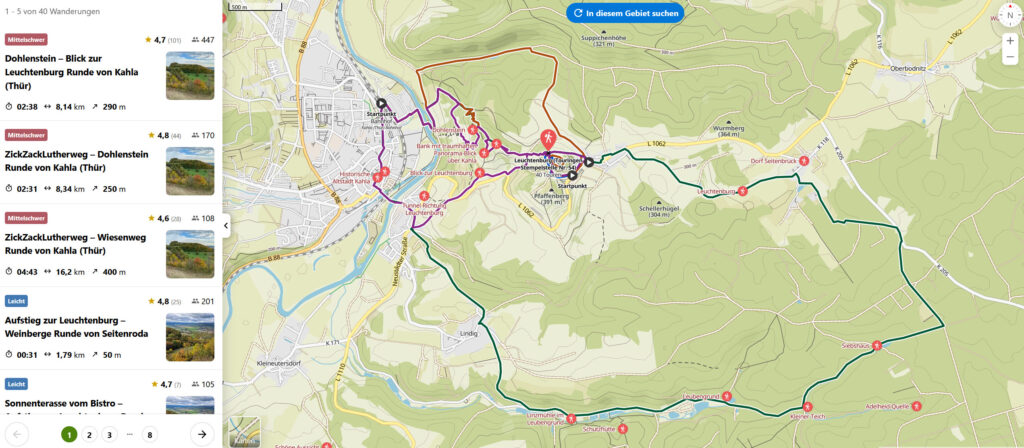
Their are multiple hikes that will take you to the castle. I rode the train to Kahla and then hiked the Dohlenstein route on the west side of the castle. The trail is quite steep and can be muddy in the spring, so solid hiking shoes and a pair of walking sticks are a good idea.
A very short history of the Leuchtenburg
The Leuchtenburg castle is one of only a few castles in Germany that has been occupied continuously since the middle ages. The castle was first mentioned in 1221 as the family seat of the lords of Lobdeburg-Leuchtenburg. The Lobdeburg family fell on hard times at the end of the 13th century and sold the castle to the Counts of Schwarzburg, who later passed it on to the Wettin Dynasty in 1396. The Wettins maintained the Leuchtenburg as the administrative center of their many fiefdoms until 1705.
From 1724 to 1871, the castle was in use as a prison, poor house, and insane asylum. After that, a hotel and later a youth hostel were operated out of the castle. In 1997, the castle was opened as a museum. Since 2007, the castle has been managed by a foundation that has substantially renovated and improved the castle.
Slings and Arrows
Although the original castle was built in the 13th century, the Leuchtenburg contains additions from almost every century since then. In the mid 15th century, the curtain wall surrounding the keep was rebuilt to include four defensive towers. The arrow slits in the towers reflect the prevailing defensive artillery of the time. Whereas longbows could be shot through tall and narrow slits, the slits at Leuchtenburg were intended for crossbows and black powder weapons. Crossbows were much heavier than longbows, albeit more powerful, and it was necessary to have a small bench on the interior of the slit so that the archer could rest the bow while firing it down on besiegers.
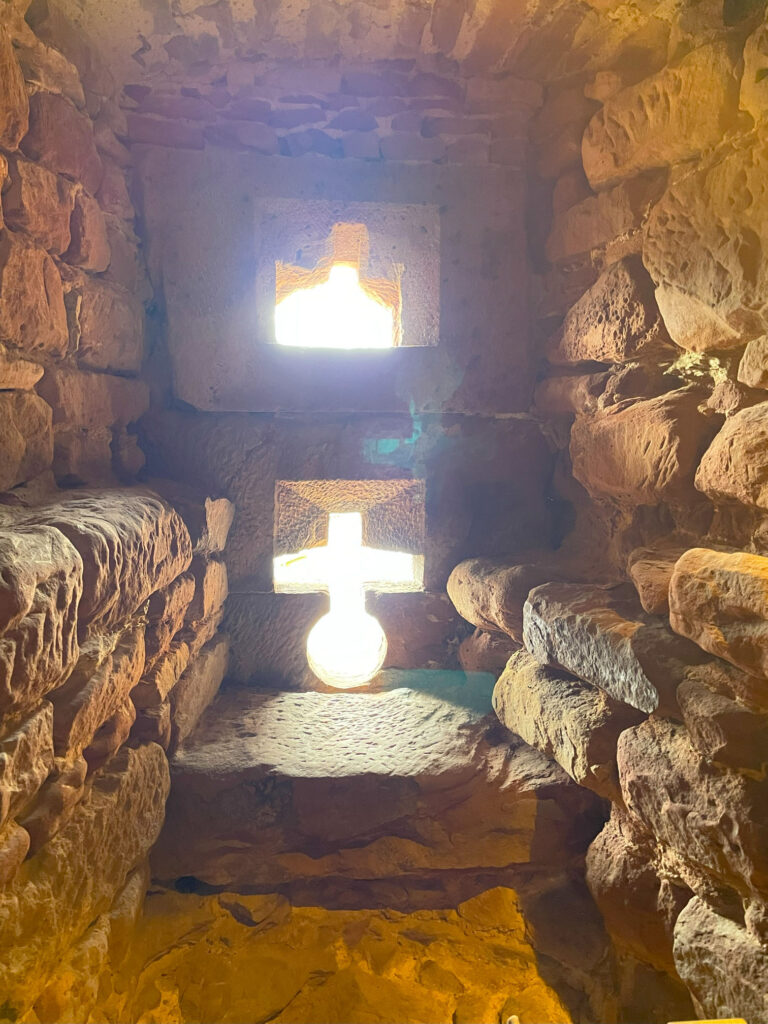
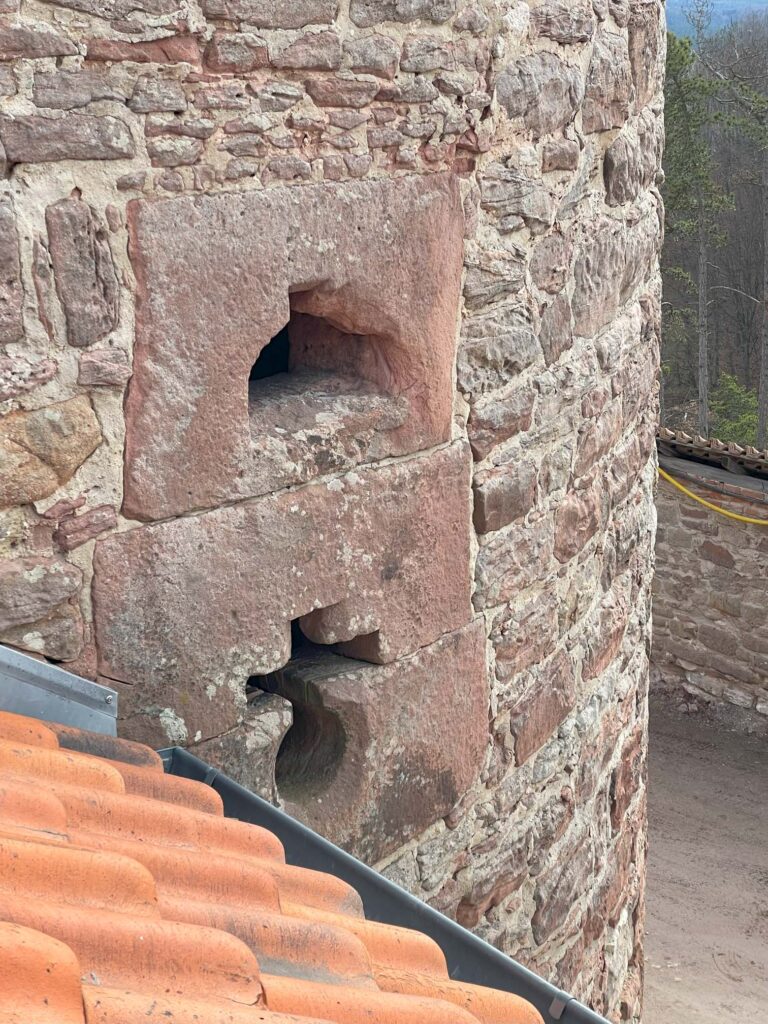
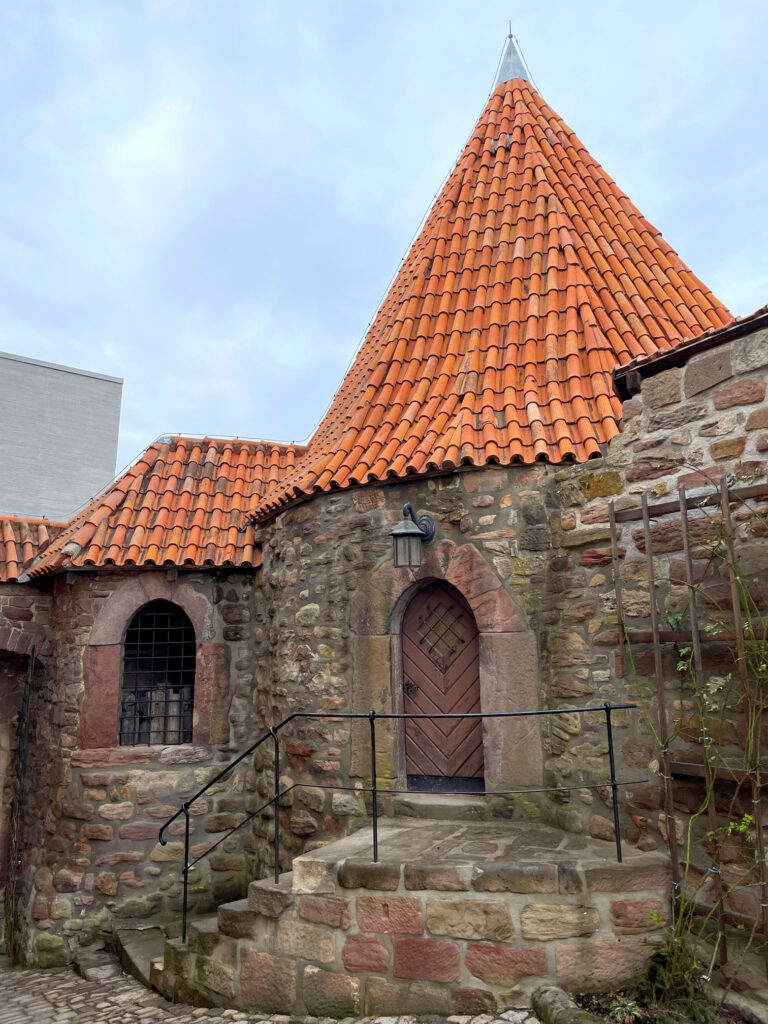
I wasn’t able to find any reference to a siege in the history of the Leuchtenburg castle, but it’s always good to be prepared.
Medieval Elimination
If you visit the Leuchtenburg today, there are clean, modern facilities should you be in need of a restroom. In the middle ages, though, toilets were decidedly less hygienic. In some castles, a type of private indoor plumbing was provided for the lord of the castle, although the waste was still directed outside to the open air and not to a sewer or septic field. The typical resident of a castle would retire to an outhouse that clung to the curtain wall of the castle. In the photo on the right, you see the corbels that support the toilet shown in the left photo.
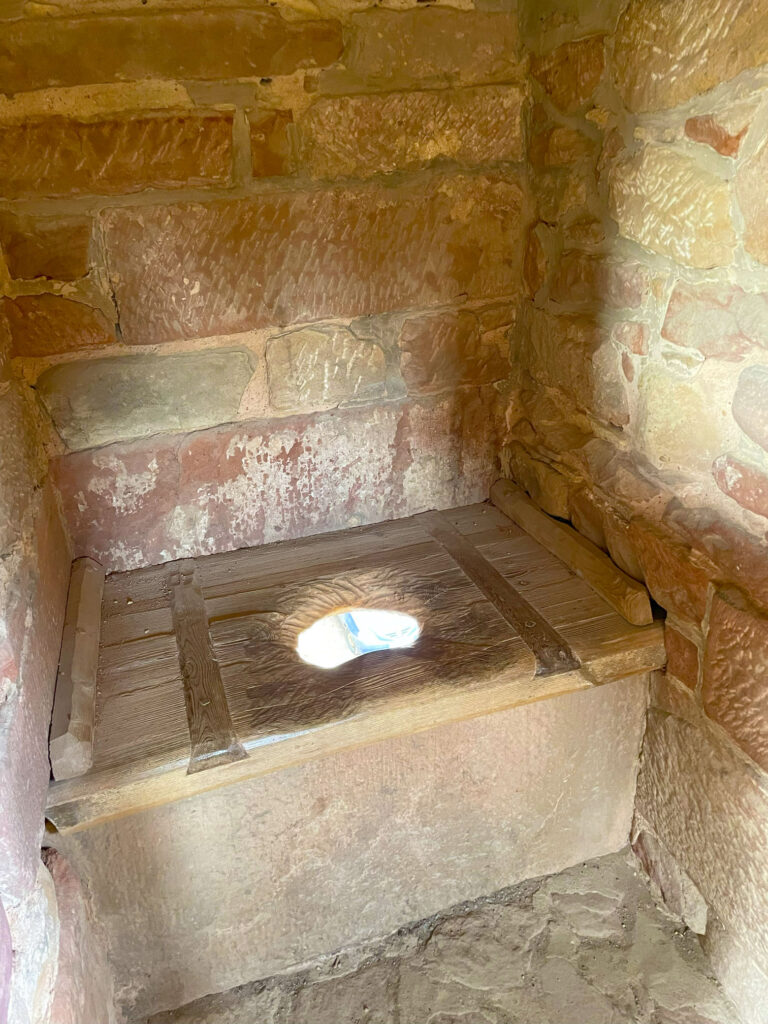

Where did the waste go? It was directed it into a moat, making the moat even more of a deterrent to enemies, into a river, or into a pit. Pit waste was regularly removed and used as fertilizer in the fields, a kind of medieval upcycling. According to the Youtube channel, A Pinch of History, castle dwellers would hang their clothes near a toilet so that the urine smell would repel insects from their clothing. Flea bites were a common problem in castle life.
Defensively, the toilet was a weak point in the castle wall. In the year 1203, attackers climbed the latrine shaft of the Chateau Gaillard on the River Seine in France and entered the castle during a siege. After that, the shaft was protected to prevent besiegers from entering this castle this way.
Porcelain in the Saale Valley
You’ve probably never thought much about porcelain, but this delicate yet robust pottery has had a long and important history in the Saale Valley of Germany. The story of porcelain is told in a fun and interactive exhibit in German and English at the Leuchtenburg “Porzellanwelt” museum. Marco Polo first brought porcelain from China to Europe in the 14th century, traveling along the treacherous Silk Road. It was immediately embraced by the nobility because it was so beautiful and refined compared to native European ceramics at the time.


Europe was desperate to discover the secret recipe to make its own porcelain. This was accomplished in 1708 by Johann Friedrich Böttger, an alchemist imprisoned and commanded by Augustus the Strong to make gold. Instead, he discovered the formula for white gold, porcelain, and was awarded his freedom. From then, porcelain was produced in Europe with uniquely European motifs. In Thuringia and Saxon, where all of the mineral resources to manufacture porcelain as well as wood to fuel kilns could be found, the porcelain industry boomed. It is estimated that in the 19th-20th century there were 300 porcelain companies present in this area of Germany.
Early Bloomers
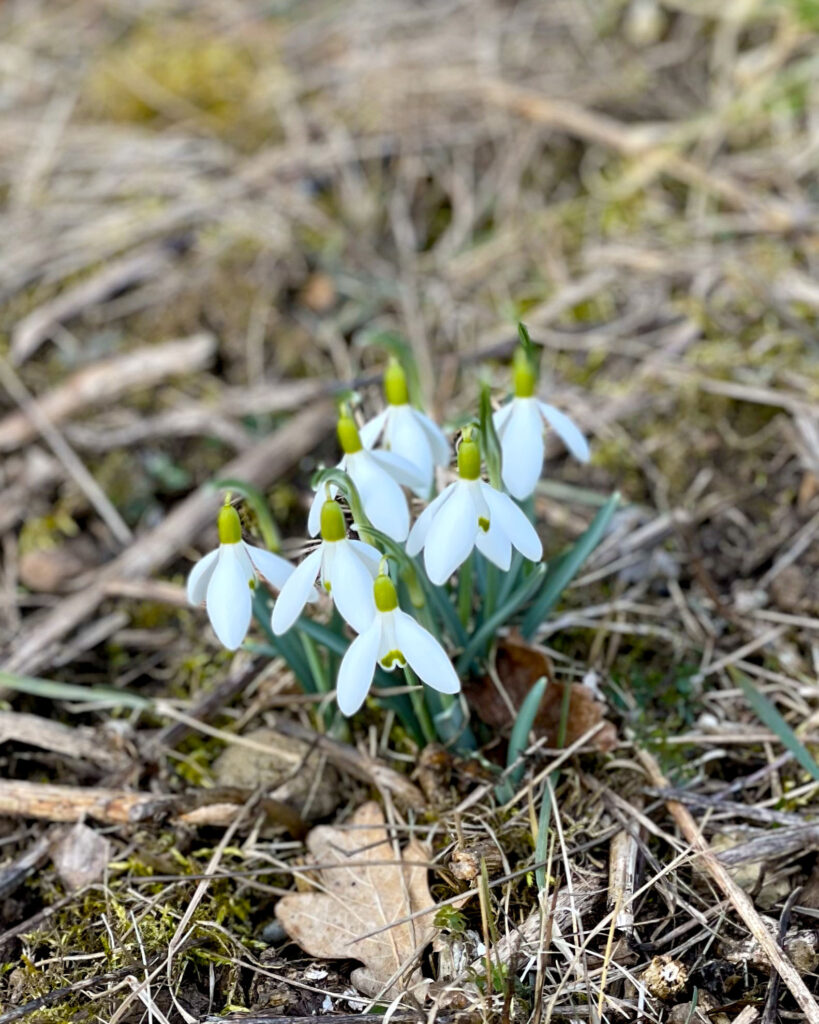
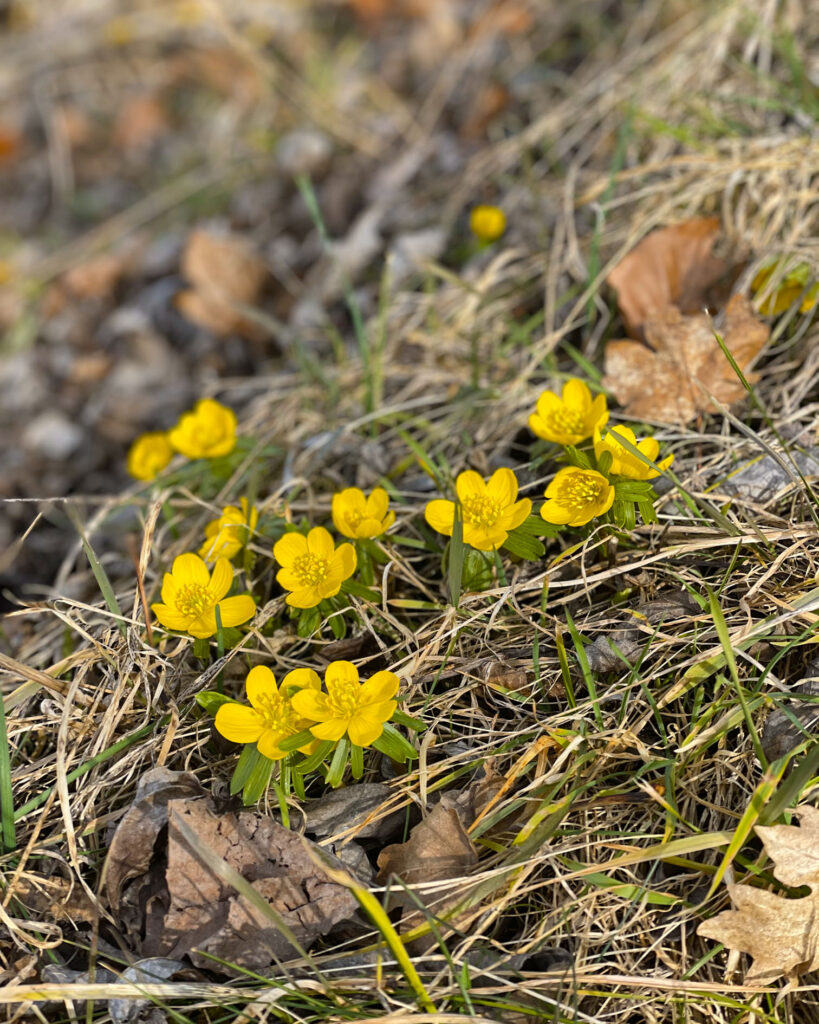
In German, the expression “Frühblüher,” or early bloomers, refers to the first flowers of spring. When you see a snowdrop or buttercup peeking out of the ground to soak up the light before the forest leafs out, it feels like winter will soon be over. The snowdrops (Schneeglöckchen), are Galanthus nivalis, a flower in the amaryllis family. The buttercup (Winterling), is Eranthis hyemalis and related to the north American Ranunculus spp. It typically has 6 petals, not 5, and doesn’t grow as tall as the American buttercups. The European buttercup doesn’t need a long stem. In a deciduous forest in February, you have all the light you need.
Sketching the Leuchtenburg
My first sketch of the Leuchtenburg was made easier by the judicious placement of a bench in the exact spot where I wanted to sketch the castle. The bench was donated by the Sparkasse bank, and I will forever be grateful for their forethought. The ink part of the sketch was finished on-site, but I finished the watercolor at home.
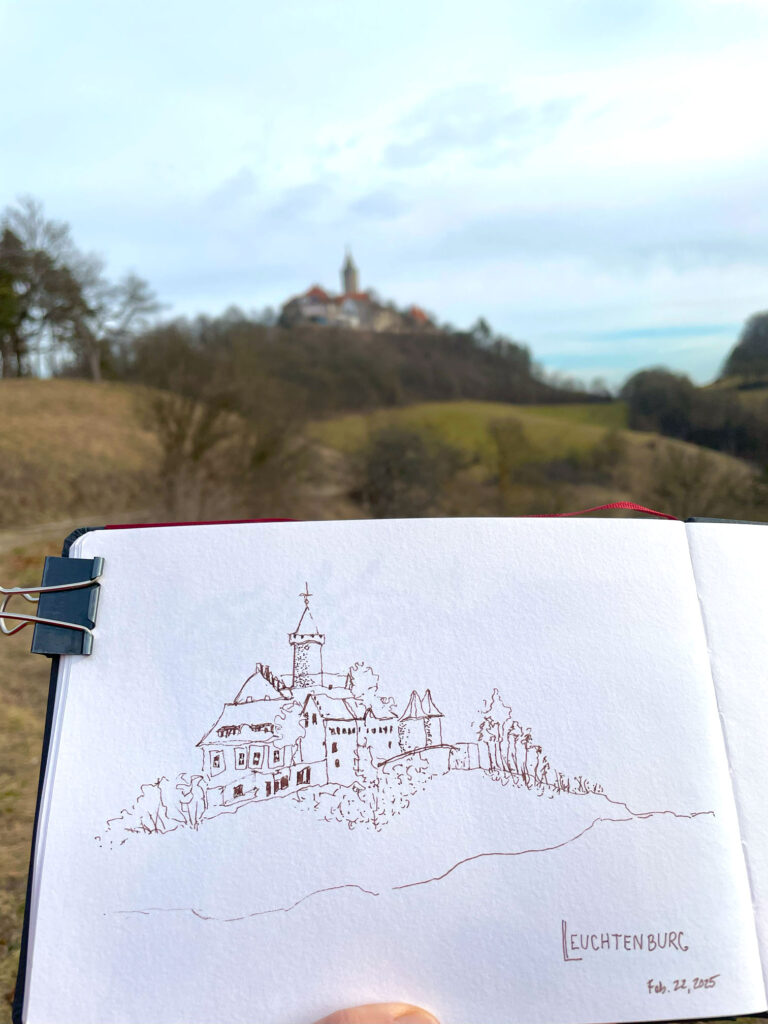
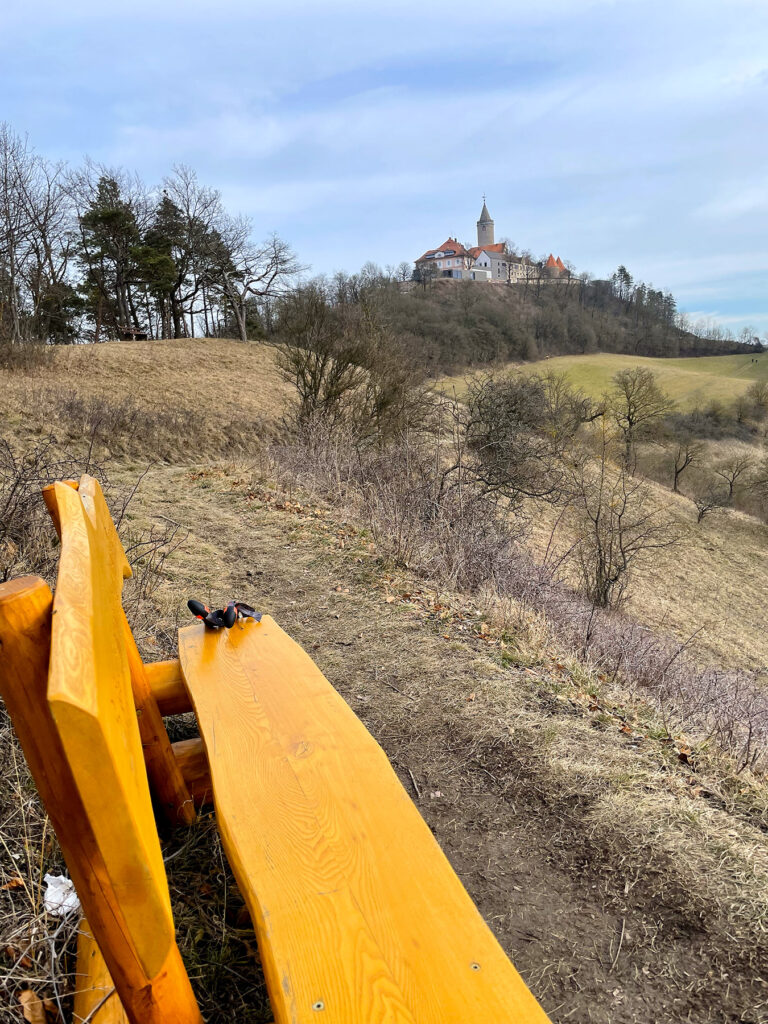
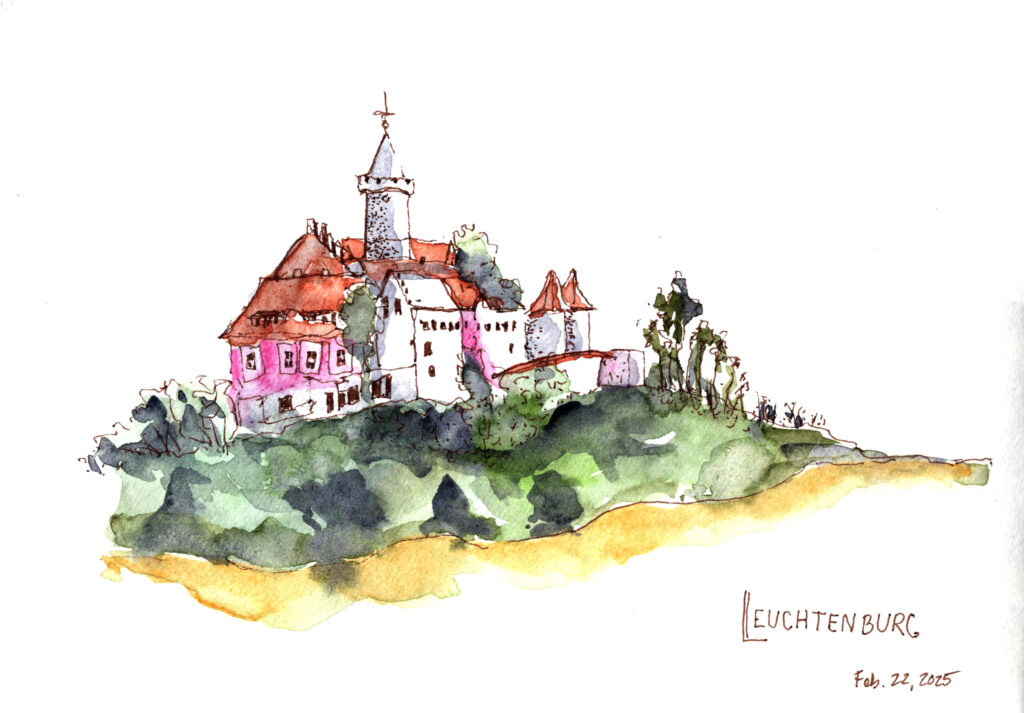
It’s impossible hike to 395 m above sea level and not take advantage of the view for a little watercolor painting. I sat with my coffee and water brushes at the visitor’s center and soaked up the amazing view of the valley.

Old Timer in Kahla
On my way down the hill to the train station, I met this elderly statesman in Kahla. He was very chatty, and promised to tell me more about the history of the castle if I returned and brought him some cheese.
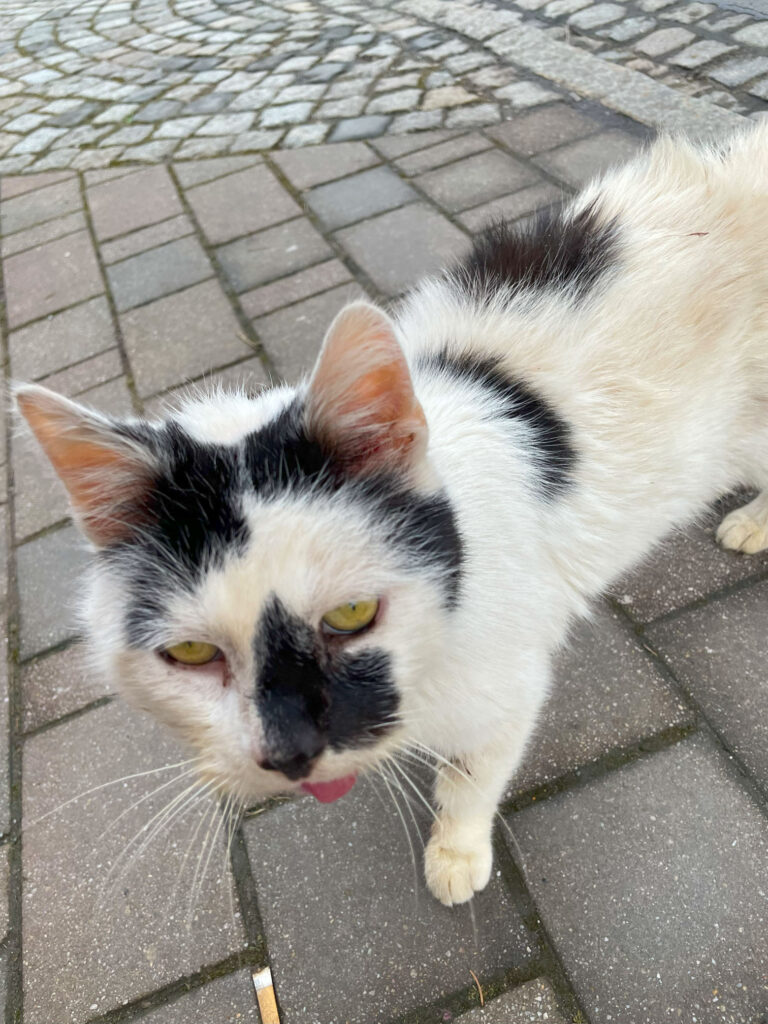
I hope you’ve enjoyed my excursion to the wonders of the Leuchtenburg castle, and I hope you’ll have a chance to visit it yourself someday. If you do, don’t forget to bring some cheese for my friend.
