

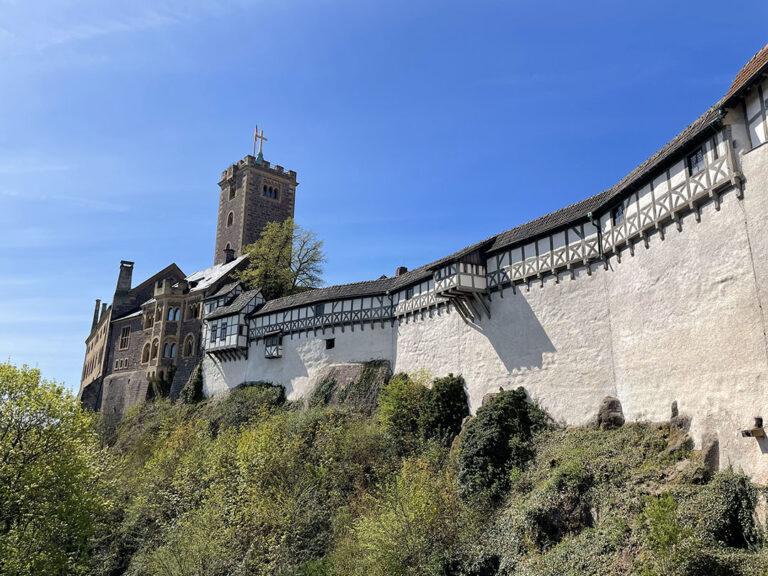
Rich in culture and the single most important castle in the history of the Reformation in Germany, the Wartburg in the city of Eisenach in Thuringia. It is here where Martin Luther translated the bible into German and plotted to democratize the Christian church. I visited it on a sunny day in April and saw a lot of sketchable sites.
How to Get There
Eisenach is easy to get to by train. I walked from the train station to the main market square, and then followed this Komoot Hike to Wartburg . The hike is steep but relatively short, and takes you to an elevation of 387 m (1270 feet) above sea level. Along the trail, there are informational signs with tidbits from Martin Luther’s life. On one board he is quoted as saying, “Des Lebens beste Gefährtin ist eine Frau,” meaning, “life’s best companion is a woman.”


If you prefer to drive to the castle, there is a parking garage located most of the way up the hill. Until 2020, it was possible to ride a donkey to the castle, but now the only asses are the wooden ones at the former donkey station. For visitors with mobility issues, there is a shuttle bus that will take you to the front gate of the castle. Please note, however, that many parts of the castle have stairs and are not wheelchair- or walker-accessible.
History of the Wartburg
The Wartburg was first mentioned in the year 1067 by a count of Schauenburg, Louis the Springer. Legend has it that, when his right to build here was disputed, he had dirt from some of his other properties transported to the hill so that he could make the dubious claim that he was ‘building on his own soil.’ Despite its shady beginnings, the Wartburg became an important cultural and historical center.
The early 13th century saw a bloom in culture at the Wartburg when Landgrave Hermann I invited artists, musicians, and poets to his court. They staged a minstrel singing contest, the famous “Sängerkrieg,” where they performed their poems set to music. Richard Wagner was so enchanted by this story that he incorporated it into his opera, “Tannhäuser” in 1842.
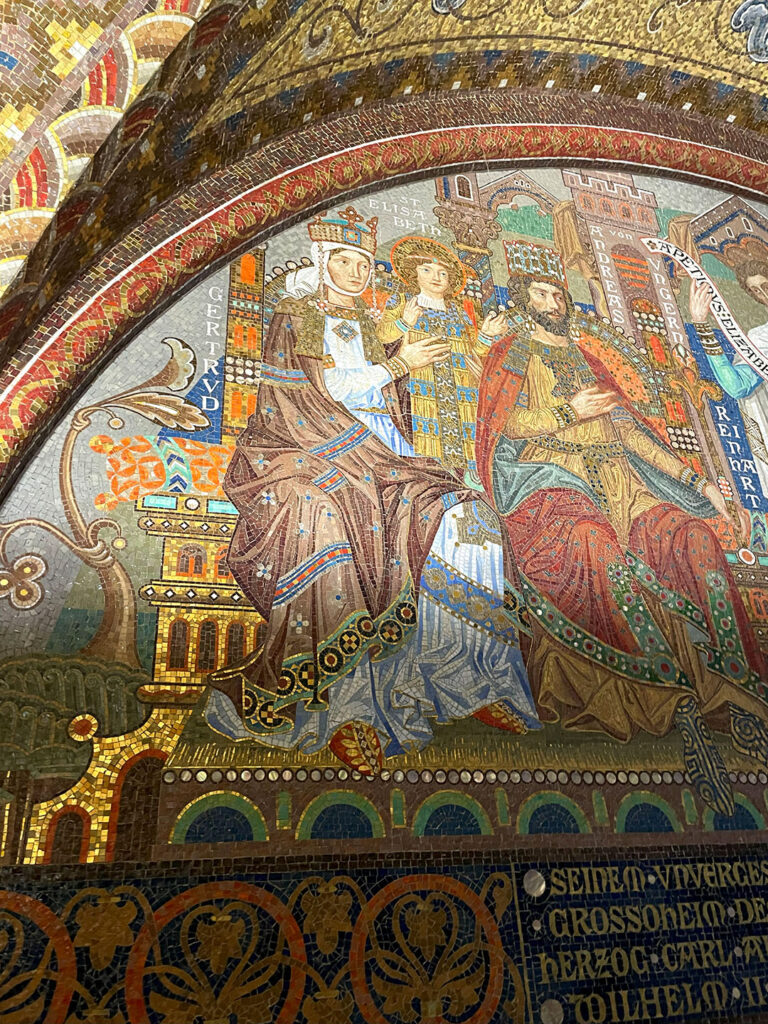
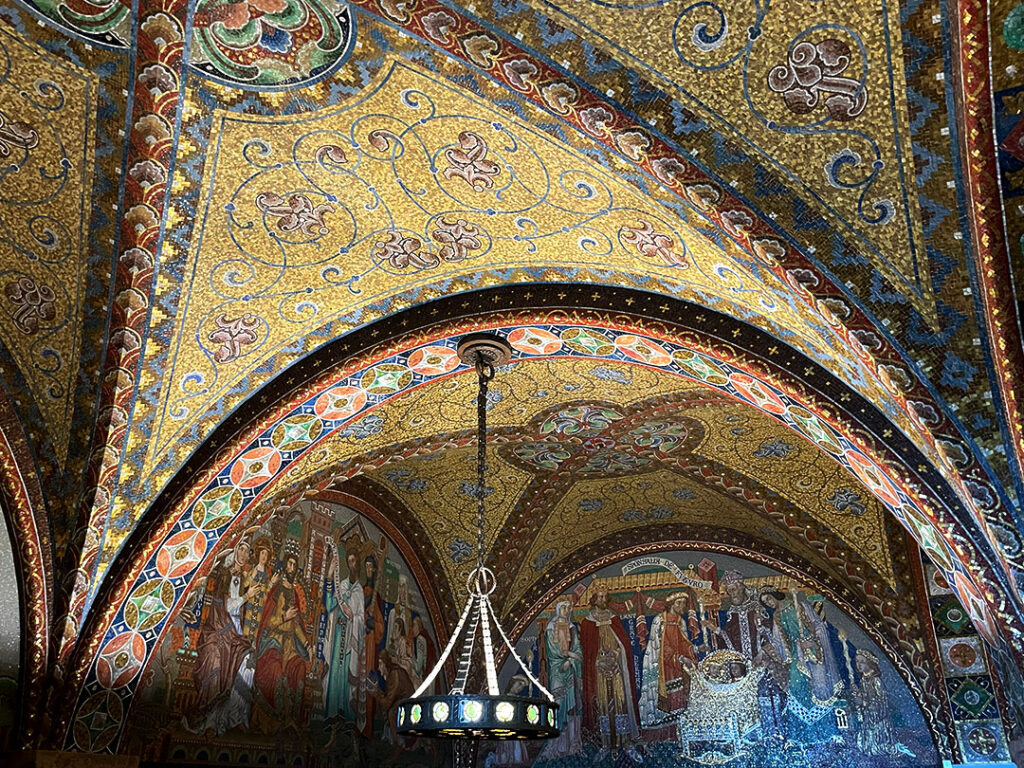
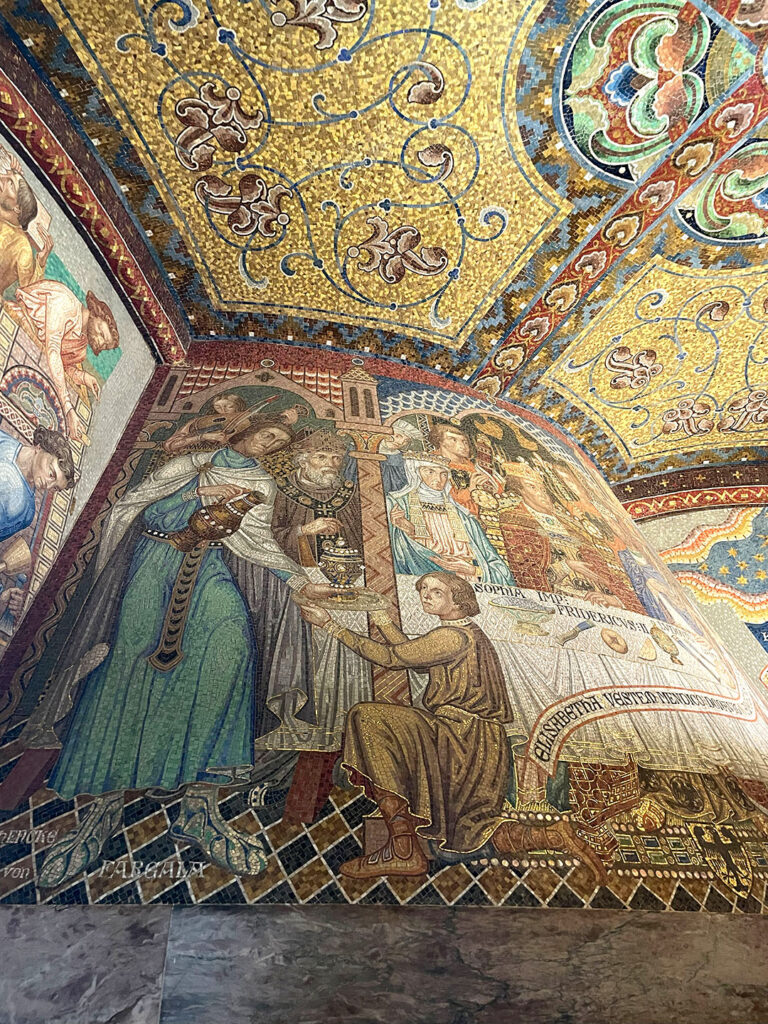
The largest building of the Wartburg is the Romanesque-style palas, considered one of the best-preserved examples of non-religious Romanesque architecture north of the Alps. It houses the great hall, the ballroom, and a hall of intricate mosaics depicting the life of Saint Elisabeth.

Holy Elisabeth
The Wartburg castle set the stage for the sainthood of Holy Elisabeth of Thuringia. Born in Hungary to a noble family, she was betrothed to the Landgrave of Thuringia, Ludwig IV, as a child. Barely out of toddlerhood, she was brought to Thuringia to prepare for her future as a noble wife. Elisabeth married Ludwig when she was 14 and he was 17 at St. George’s church (Georgenkirche) of Eisenach.
Elisabeth’s closest spiritual advisor was a friar of the Franciscan order. In the 13th century, the Franciscans had adopted the doctrine of apostolic poverty. They eschewed the large agricultural holdings and wealth of traditional monastic orders, and instead devoted themselves to lives of poverty, chastity, and obedience. Motivated by this new spirituality, Elisabeth donated much of her possessions to the poor, including costly royal robes and jewelry. She opened granaries belonging to the Landgrave to feed the poor, and she established hospitals throughout Thuringia. Ludwig’s court was aghast at this shocking use of the Landgrave’s wealth, but Ludwig approved of her generosity.
Four years after her death in 1231, Elisabeth was recognized by the church as the “Heilige Elisabeth,” (Saint Elisabeth), for her selfless acts of charity. At the Wartburg, the “Elisabeth-Kemenate” hall tells the story of her life in glistening golden mosaics.
The Wartburg and the Reformation
If you’re a Lutheran and know the history of Martin Luther and the Reformation, you can skip this part. If not, to understand the importance of this castle, you’ll need a quick summary of how the events of the 16th century permanently changed the Christian church.
Martin Luther was an educated man, and he thought about Christianity a lot. In particular, he had the ability to read and understand the Bible himself, without relying on interpretations from the Christian church. He surmised, from his study, that the church was not being very Christlike, and he made his objections known by posting 95 thoughtful ‘suggestions’ for change on the door of the church in Wittenberg, Germany in 1517.
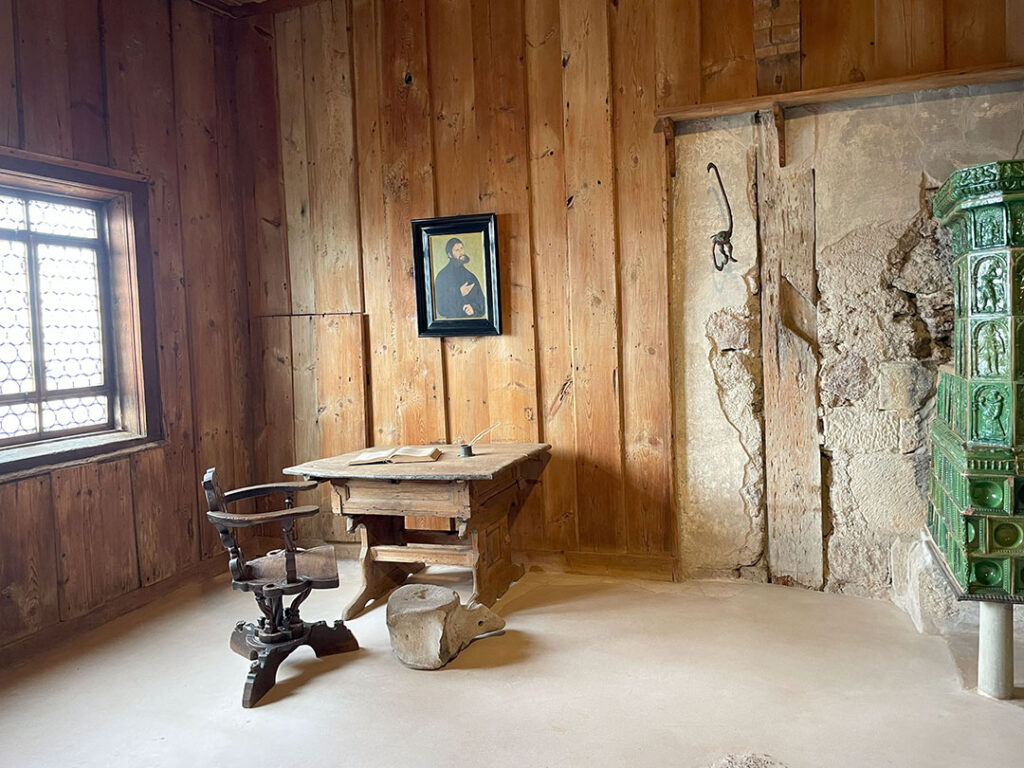
As you might imagine, his 95 Theses went over like a lead balloon with the church. They decided he was a heretic, a crime punishable by being burned at the stake. To escape this fate, he went into a sort of medieval witness protection program, adopting the persona of “Junker Jörg,” (the squire George), and hiding out at the Wartburg castle. During his time there, he occupied himself by translating the bible from Greek into German and screaming at pigeons to get off his lawn (see “Symbols of Peace?” below). His bible translation, while not the first translation of the text, was one of the more popular and widely distributed at the time. It fit nicely with his goal to make the church more accessible to the common man, and ultimately led to the Reformation and the separation of the Lutheran/Protestant/Evangelical branch from the Catholic church.
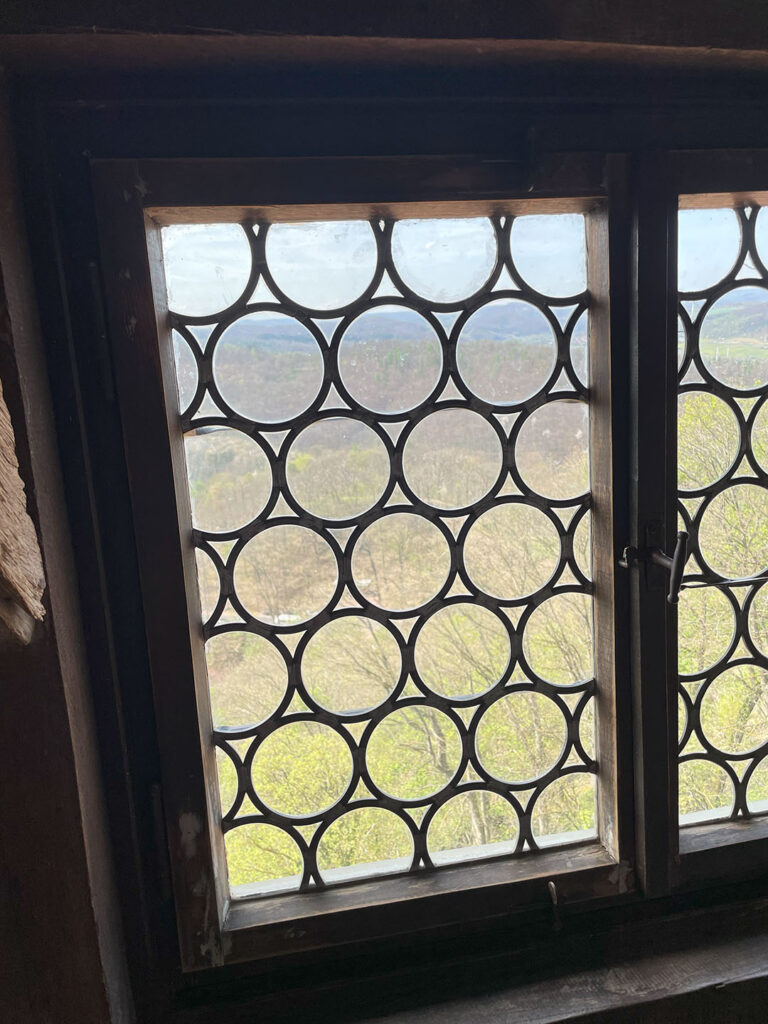
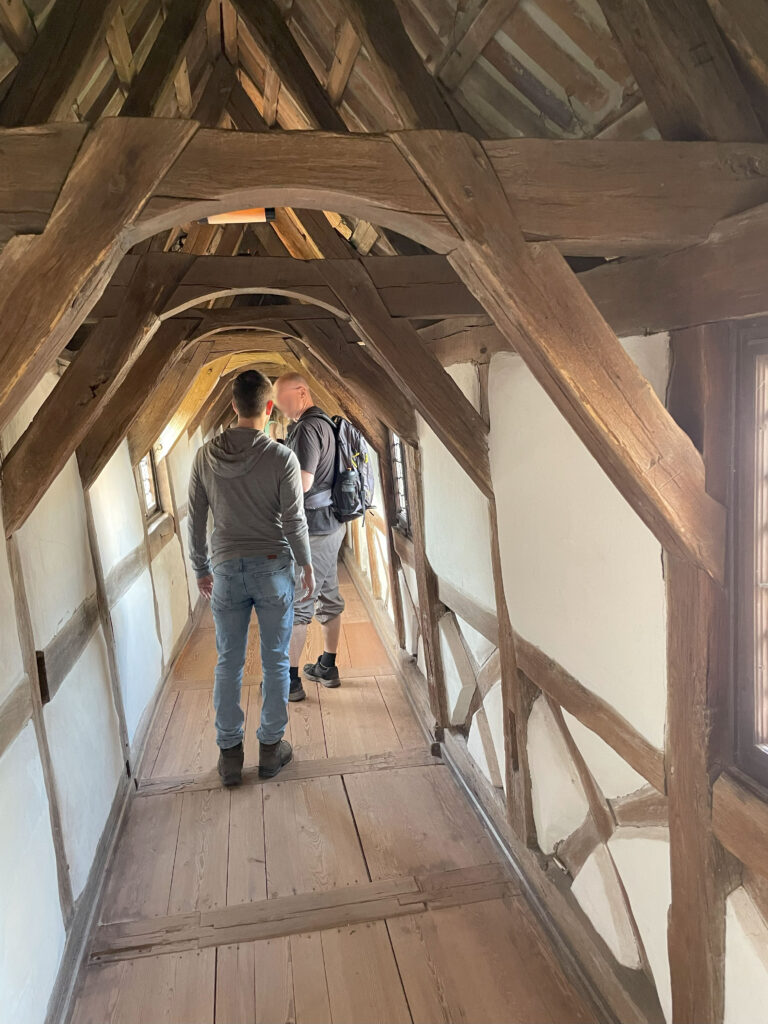
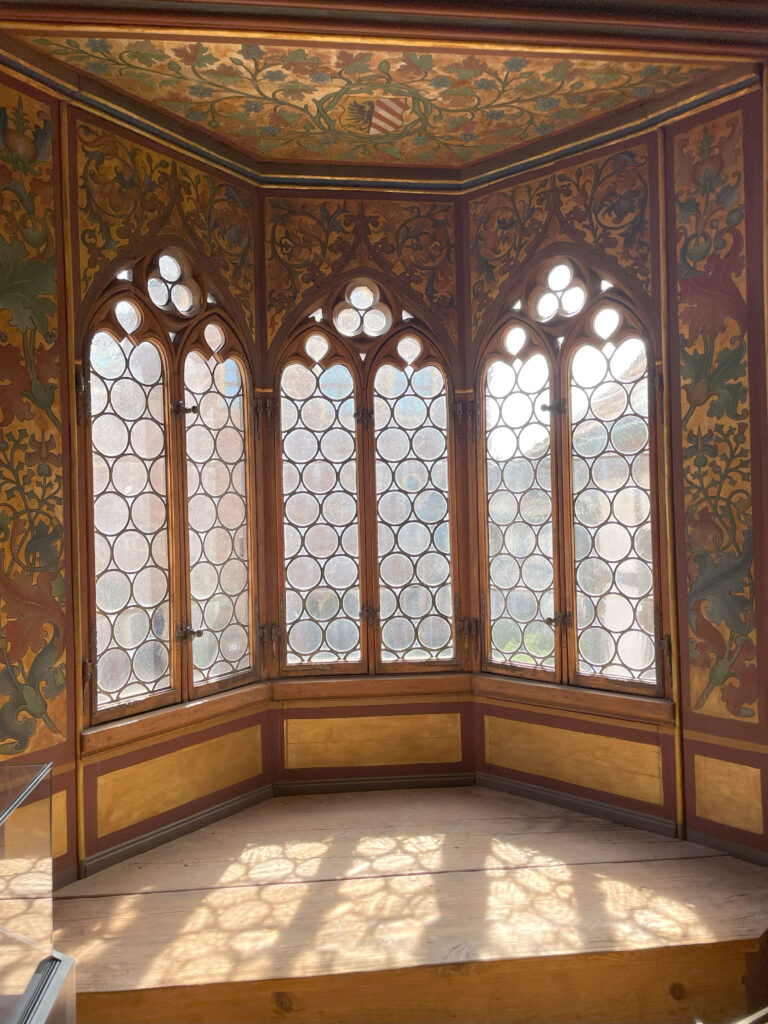
Shown below are photos of the wing of the castle where Martin Luther was hiding out, and his study where he was busy thinking his radical anti-establishment thoughts.
The Mighty Fortress is Our God
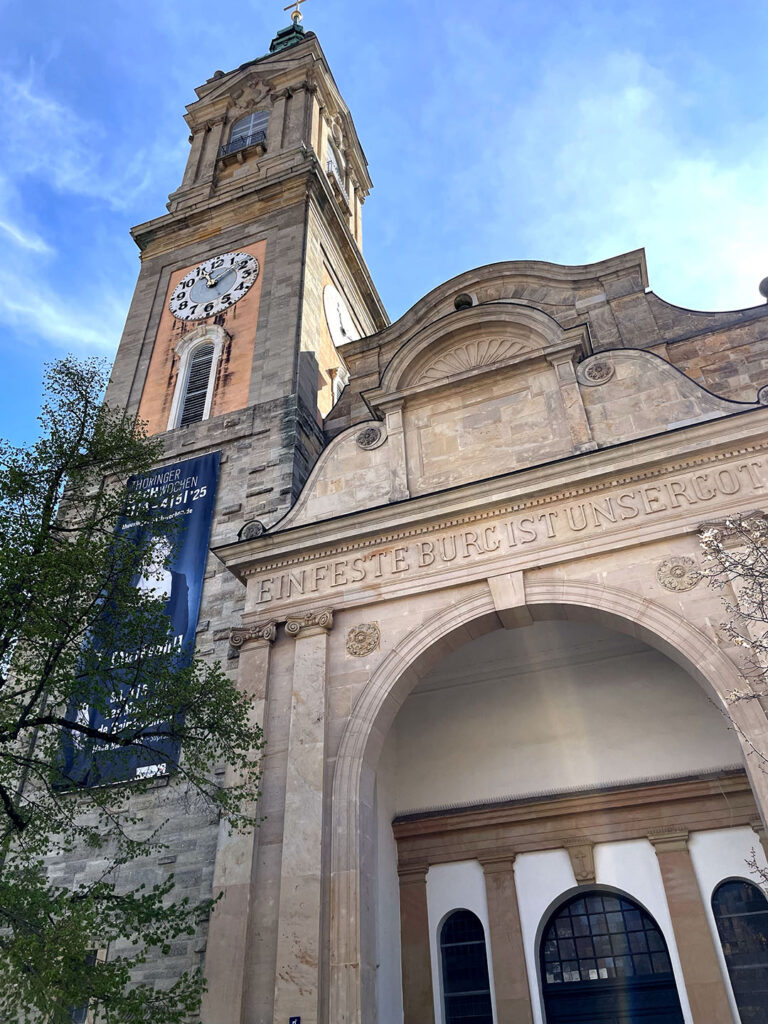
Martin Luther was a prolific hymnodist (a person who composes hymns). Well-known among protestants is the hymn “The Mighty Fortress is Our God,” translated from the original German, “Ein feste Burg ist Unser Gott.” This hymn is memorialized on the west portal of St. George’s church. The fortress referred to in this hymn is, you guessed it, the Wartburg.
The construction of St. George’s church began in 1129 and went through many additions and renovations, as have most old European structures. The tower, added in 1902, was inspired by the cathedral tower in Monza, Italy. From 1665 to 1797, several members of the Bach family, including Johann Christoph Bach, Johann Bernard Bach, Johann Ernst Bach, and Johann Georg Bach, all served as organists in the church. The infant Johann Sebastian Bach was baptized here in 1685 in a baptismal font that dates back to 1503 and is still in use today. Martin Luther attended latin school here as a student and later preached in the church.

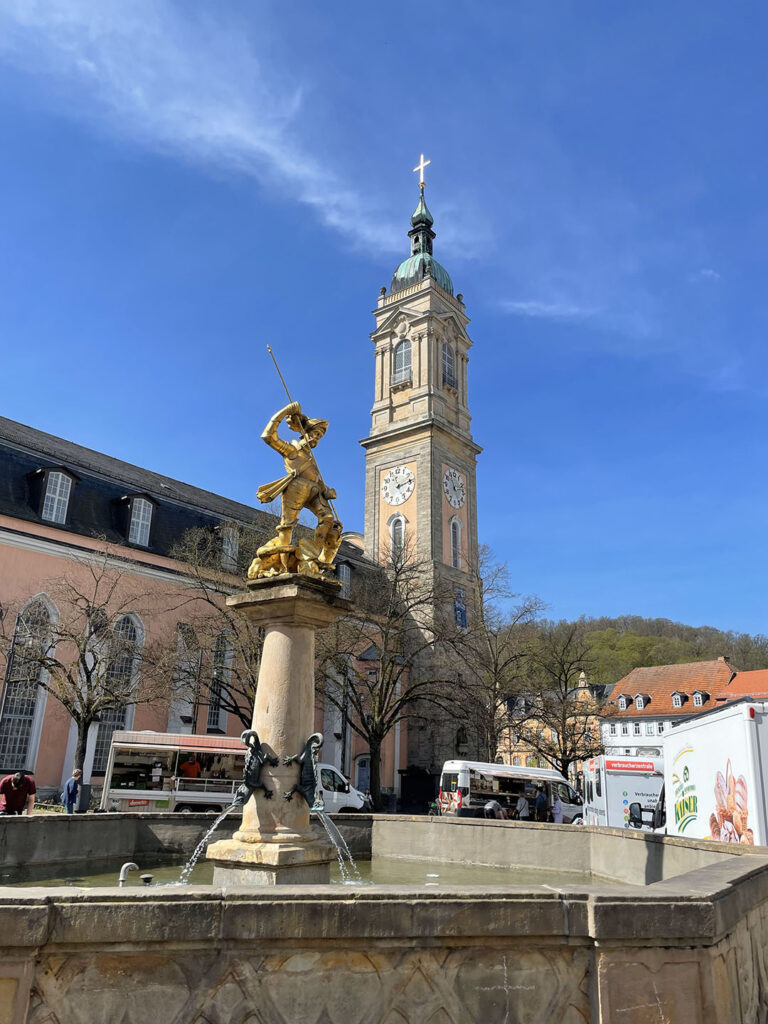


The fountain in the market square of Eisenach was built by the stonecutter Hans Leonard in 1549. It portrays St. George, the patron saint of the city, slaying a dragon. At the base of the fountain, there are smaller dragons spurting water into the pool below. It’s kind of a “Hingucker,” as Germans say, an eye-catcher that attracts crowds. It attracted me.
There are lovely cafés around the Eisenach market square. I found one where I could sit and sketch while enjoying a delicious mango ice cream sundae.

Symbols of Peace?
One of the unexpected delights of visiting the Wartburg castle is a kit of white fantail pigeons that roosts in tailor-made cavities in one of the half-timbered buildings. Their origin is disputed. It’s possible that they arrived with toddler Elisabeth of Hungary in the 13th century as part of her dowry, but some references claim these tiny white peacocks didn’t arrive on the European continent until much later than the 13th century.
The pigeons were probably at the Wartburg by the time Martin Luther took up residence in the castle. A legend, unsupported by a reliable historical source, is that he saw the shadow of a pigeon on the windowsill of his room and assumed (as he often did) that it was the devil. In contrast, the story that he saw the devil in his room and discharged the evil shade by throwing his ink pot at the wall is well supported. Souvenir seekers scraped that wall for centuries.
I found the Wartburg fantail pigeons to be completely delightful and not at all devilish.

Sketching the Castle
Sketching at a UNESCO world heritage site with a constant march of tourists can be a challenge. I managed to find a cozy spot in a corner next to a backhoe, but still with a panoramic view of the castle and even a little shade, at least for part of the sketch.
A few tourists managed to find me and stopped to chat, and that’s always lovely. I’ve found that when you’re sketching in an obvious tourist spot, people feel more emboldened to approach you. Maybe they assume you’re a planned part of the tourism landscape? I don’t know. But if I’m enriching someone’s experience of a place, that brings me joy. I want people to go out and see stuff, even if it’s a weird woman with a sketchbook, as that’s kind of the mission of this blog.
In Jena, where I live, the only person who’s ever stopped to chat while I was sketching was a street person enjoying his morning beer. For the record, he has an advanced understanding of perspective.


To demonstrate the fact that the Wartburg is an eminently sketchable castle, here is a drawing of it from 1777 by none other than Johann Wolfgang von Goethe himself.

I hope you have enjoyed this trip to the Wartburg, and I hope you’ll get a chance to visit it yourself someday. If you would like to take a tour of the castle in English, please inquire at the ticket counter about the “Whispers of History” tour. It is guided by an English speaker and is offered every day at 1:40 pm. German tours are offered every 20 minutes.
