

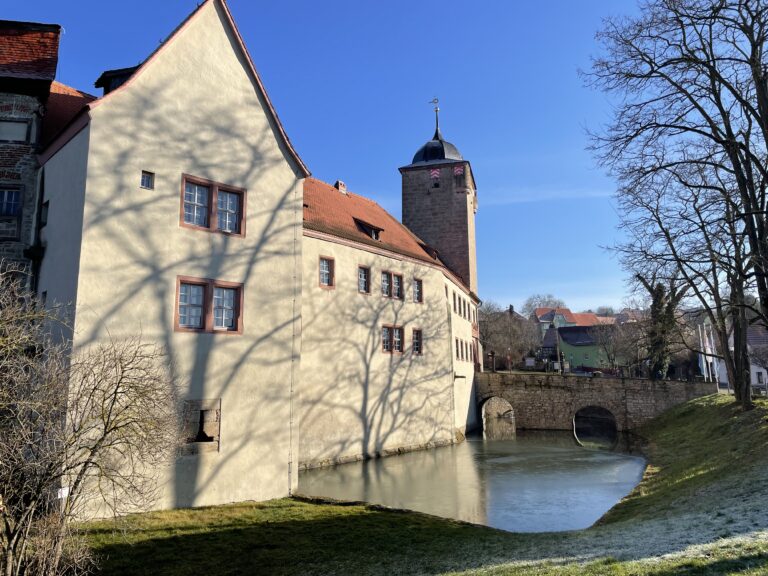
To kick off my Castle Hike blog, I visited a castle with a moat in the village of Kapellendorf. As I was doing research for this post after my trip, I ended up down a rabbit hole, and that rabbit hole contained a medieval recipe for roasting oxen, which ironically could include rabbit.
How to get there
The Wasserburg Kapellendorf is located about halfway between Jena and Weimar, Germany. Drive to the village of Frankendorf on the B7 and follow the signs to Kapellendorf.
If you don’t have a car, you can take Bus 280 from the Jena Busbahnhof to the Globus Isserstedt stop, and then Bus 255 from Isserstedt to Kapellendorf.
I was planning to hike (because this is a blog about hiking, not just about castles) from Frankendorf to Kapellendorf. It looked like an easy flat hike, suitable for a cold January day, but the trail app showed me a perfectly rectangular loop trail for this route. What this trail shape means is a lot of skirting farmer’s fields, and while allowed here in Germany, it’s usually not the most scenic nature experience. So, I decided to drive straight to Kapellendorf.
What is a “Kapellendorf?”
Kapellendorf means “chapel village” in German, and refers to a church built here in the 9th century. In 1235, the Order of Cistercians established a convent at the church where the sisters ran a successful agricultural and spiritual enterprise until the Reformation. The church then converted to Protestantism, became the property of the community, and was renamed the church of St. Maria und Bartholomäus. During the 1970-80s, the structure was extensively updated as you can see from the large, modern windows in the 4th and 5th photos. The organ dates from 1910.

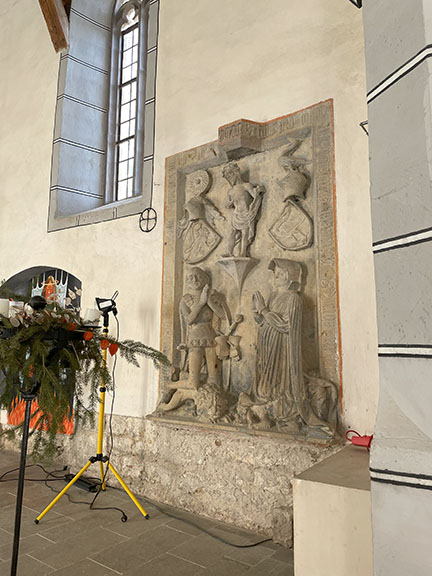

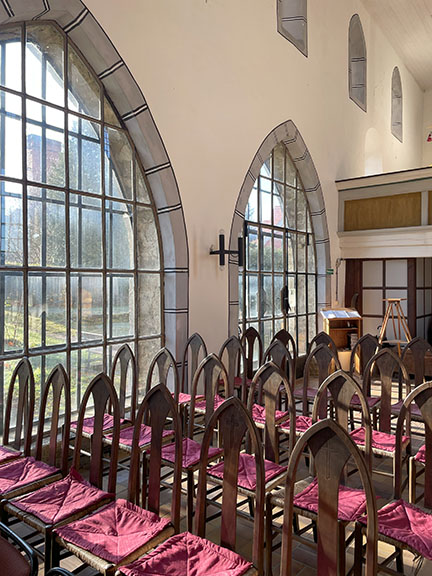
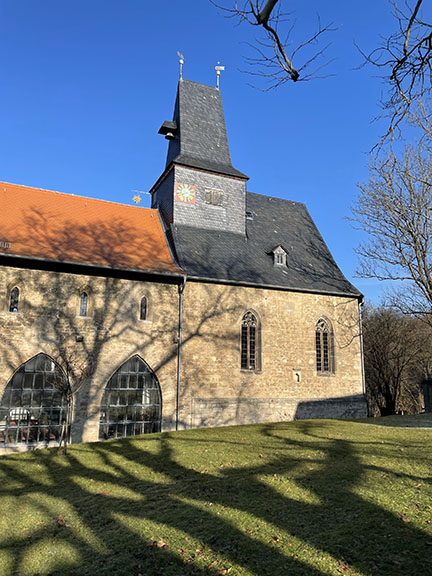
The Kapellendorf Castle had a moat.
One common misconception about castles is that they were all surrounded by moats. Not true. Moats were only dug around castles that lacked the defensive advantage of being situated on a hill. Since the Kapellendorf Castle is located on flat land, it required a moat.
A moat is a ditch dug around a castle, and it can be filled with water or simply left dry. It worked by preventing siege engines (like trebuchets or siege towers) from approaching the curtain wall of the castle. (If you’re not sure what a siege tower, a trebuchet, or a curtain wall is, check out the castle glossary.) Moats also discouraged tunnel digging, another siege tactic.
The Kapellendorf is one of the largest and best-preserved moated castles in Thuringia. From the 8th to 10th centuries, it was likely a simple motte-and-bailey castle surrounded by a ditch. The current moat is about 30 meters wide.


Did moats have crocodiles swimming in them? There’s no evidence for creatures not adapted to harsh European winters being maintained in moats. The Český Krumlov Castle in the Czech Republic, however, does have a bear moat which exists to this day, complete with ursine occupants. It’s possible that some dry moats were planted with stinging nettle, something not quite as daunting as bears, but could slow down the enemy nevertheless.
What wildlife did I see in the Kapellendorf moat? Just this lonely duck.

Map of the castle
This map of the castle is helpful for orienting around the different structures within the castle walls. Although the moat is currently split by three land bridges, I highly doubt these existed in medieval times because they defeat the purpose of the moat entirely if your enemies can simply charge over land.
Originally, there was also a wall on the exterior edge of the moat.
Number 7, the “Zwinger” in German, represents the space between the outer curtain wall and the inner defensive wall. If sieging enemies managed to cross the exterior wall into the Zwinger, they were sitting ducks for archers hidden behind the battlements of the interior wall.
- bridge and castle entrance
- residential quarters
- original castle entrance
- horse stalls
- dungeon tower
- curtain wall
- outer bailey
- kitchen
- residential quarters
- castle center
- keep
- bower
- princess building
- judicial and administrative offices
- moat

The Oxen Roasting Kitchen
In the center of the Kapellendorf castle there is an “Ochsenbratküche,” or oxen roasting kitchen (number 8 on the map). The kitchen and accompanying fireplace are massive enough to cook one ox, or several oxen, as well as many loaves of bread to accompany the meal.

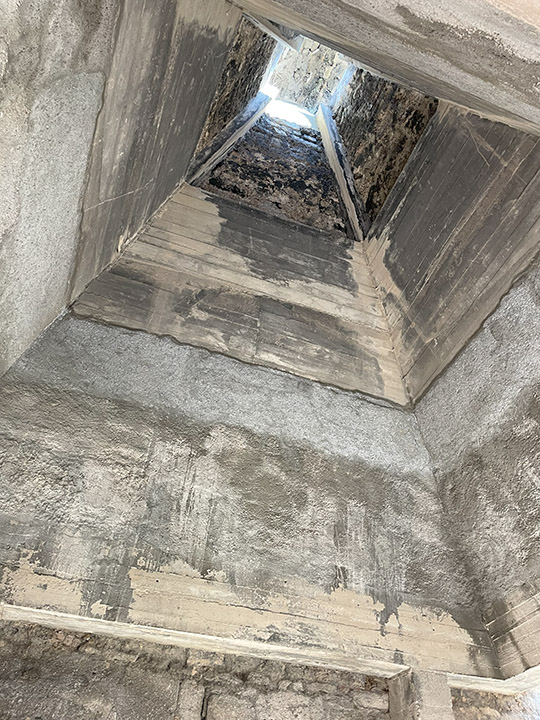

The History Museum of Frankfurt has in its collection the skulls of two oxen that were eaten in coronation feasts in the 18th century on the Römerberg. You can read the blog post in German here: Wie man einen Ochsen brät.
A coronation banquet could include roasted ox and up to 30 other dishes. Before the ox was slaughtered, the butchers paraded the decorated but doomed animal through town. For cooking, the ox was filled with sausages, lamb, veal, and lots of different poultry (and probably a rabbit or two) before being placed on a spit and roasted for a full 48 hours while a butcher turned the spit. When the strenuous roasting, carving, and serving process was finally finished, the butchers’ guild treated themselves to the heads of the oxen.
This flyer from the 1612 coronation of Emperor Matthias shows the stuffed and decorated oxen on its way to the spit. It includes a long verse on how to prepare an oxen roast. If your medieval German language skills need a test, you can read the recipe poem in the original at the link.

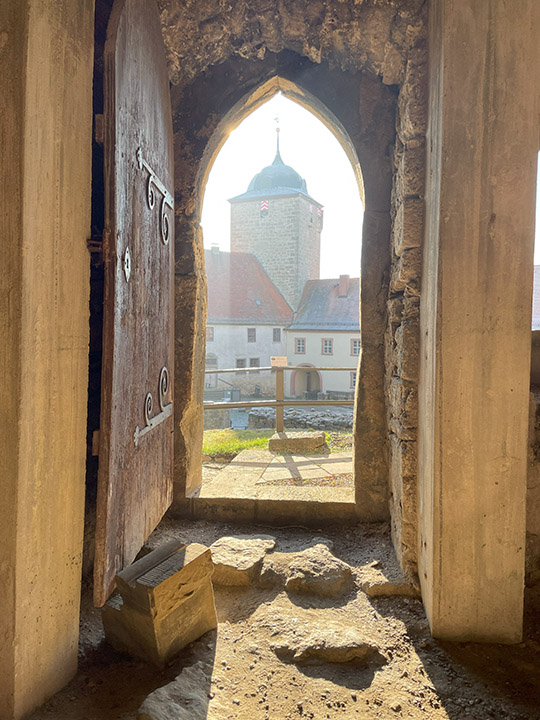
A castle community, numbering from 50-100 nobles, attendants, and servants, ate a lot of bread. To accommodate their nutritional needs, bread dough was mixed and kneaded in a 2 meter (6 1/2 feet) deep and wide pit. The bread mixing pit was lined with oak, poplar, or cedar, or sometimes carved out of an entire tree trunk. At Kapellendorf, the bread mixing pit is conveniently located next to the kitchen and within the ruins of the original round keep.

Kemenate, rhymes with Renata
The Kemenate (German) or bower (English) is defined in castle lore as a place of retreat for the lady of the house. At Kapellendorf, however, the bower is one of the tallest and largest buildings in the castle core. It was probably more of a keep than a she-shed. The keep was the strongest fortified building in a castle, used as the last safe location for a castle under siege.
The Kapellendorf Kemenate extends over 5 floors. The basement and first floor stored weapons and other goods, the second floor and fourth floor were living spaces/bedrooms, and the third floor (the largest windows in this photo) held the banquet hall. In most castles, the keep was protected by placing the entrance door above ground level. When the castle was under siege, the fleeing inhabitants pulled up the ladder to prevent their enemies from following them into the keep. The ground access you see to the gothic-shaped entrance door was probably a later addition.


Where to put the duchess
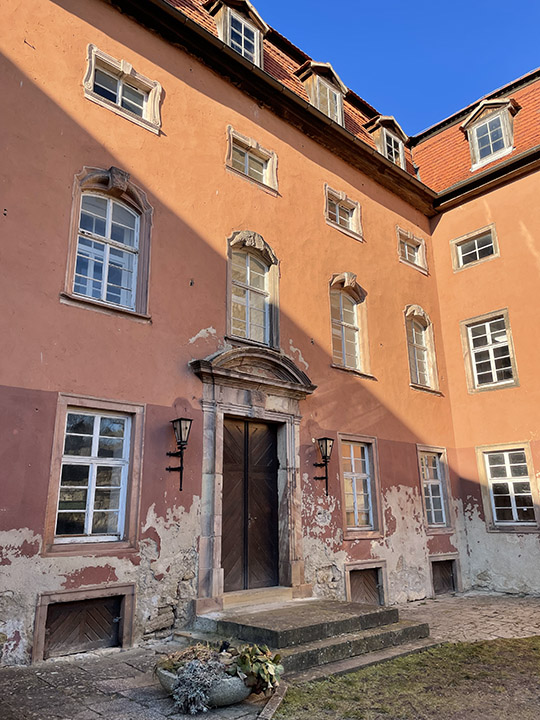
In 1719, Duke Ernst August I of Saxon-Weimar-Eisenach had a baroque addition built on to the castle. It was intended to be a widow’s residence for his wife, Duchess Eleonore Wilhemine von Anhalt-Köthen, upon his passing. Unfortunately, she died long before he did and never saw the completion of her widow’s house.
Referred to as the “Prinzessinnenbau” or princesses building, it still stands in its incomplete but still beautiful form. It was pressed into use from the 19th to early 20th centuries as grain storage space. During the GDR (German Democratic Republic), the banquet hall was used for political events. The man pictured on the left in the black and white photo is Erich Honecker, last president of the former East Germany.

Sketching outside in the cold
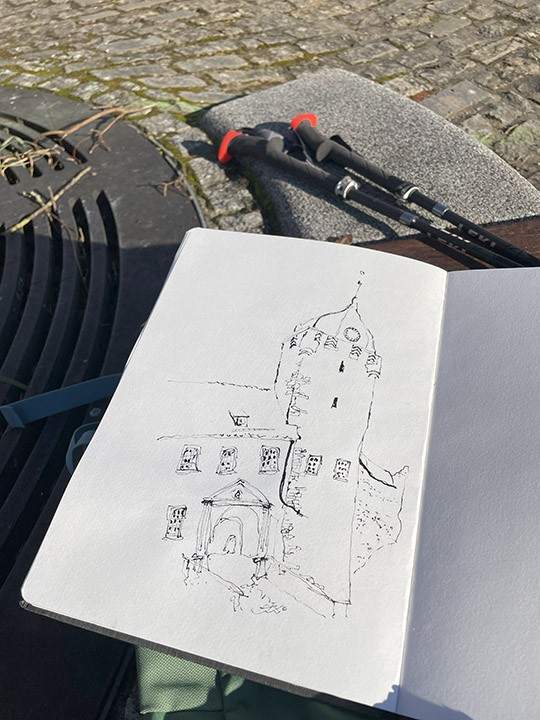
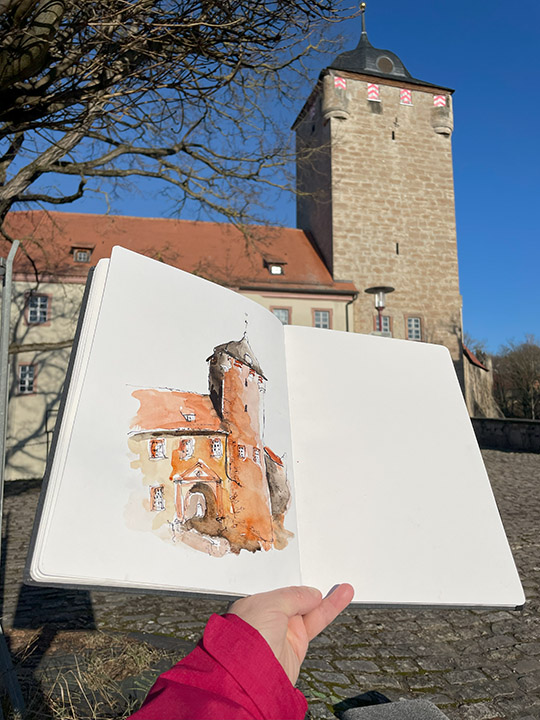
Even though the temperature was a chilly 5 °C/40 °F, I found a sunny spot (with a bench!) on the south side of the castle. I decided to draw the main gatehouse and tower. The original gatehouse/drawbridge complex was located on the southeastern wall. In the second half of the 16th century, the main castle gate was moved to a southern tower, given a Renaissance facelift, and connected with a stone bridge over the moat.
I attracted a couple of onlookers while I was finishing up the sketch. They asked if my fingers were cold, and honestly, they weren’t. The main hazard to sketching outdoors in winter is that watercolors dry slower and there are longer waits between glazes. It doesn’t matter so much for my style, because I don’t really care if things get messy. For artists who value more precision, though, cold temperatures can be challenging.

To sum it all up
The Castle Kapellendorf is a well-preserved moated castle with layers of history, offering interesting peeks into medieval life. There is plenty of cool architecture to sketch. As far as hiking and nature are concerned, it’s not the best combination of all of the things I’m trying to accomplish in this blog, but every castle experience is going to be a mix and I look forward to the next adventure.
I hope you enjoyed my first castle hike post. Although I had read about the Kapellendorf before I visited, I learned so much more by being there and seeing it with my own eyes. I encourage you to explore the interesting places near you. If you decide to write about them (or already have a blog), or if you have questions or thoughts about the Kapellendorf, let me know in the comments.

LOVE all this thoroughly researched info! I will definitely keep following you on your castle journey!!! Mega toll
Thank you!
Absolutely wonderful. I especially appreciated the castle map.
Thanks! I’m glad you liked the map.